Remote Jobs Korea 2026: Expert Guide for Foreigners
Find remote jobs korea with our 2026 guide. Explore the market, visa rules for foreigners, top roles, salaries, and how to apply successfully.
You're probably in one of three situations right now.
You want to live in Seoul or Busan and keep a remote career going. Or you're outside Korea and looking for a role connected to the Korean market. Or you already speak Korean and you've noticed that “remote jobs Korea” can mean very different things depending on the platform, employer, and visa situation.
That confusion is normal. Korea is attractive for remote professionals because the lifestyle is compelling, the infrastructure is strong, and the tech ecosystem is serious. But the market isn't a simple copy of the US, UK, or Australia. The best opportunities exist, but they sit behind real filters: legal work eligibility, language fit, role type, and employer maturity.
Most job seekers often lose time. They search broad job boards, click anything labeled remote, and assume the listing applies equally to foreigners abroad, foreigners in Korea, Korean nationals, and globally distributed Korean-speaking candidates. It usually doesn't.
A better approach is to treat Korea as a selective remote market, not a massive one. If you do that, your search gets sharper fast. If you're also comparing locations, this broader guide to the best countries for remote workers helps put Korea in context.
The Dream of Working Remotely in Korea
For a lot of professionals, the appeal is easy to understand. You picture weekday mornings in a café, evenings that don't revolve around commuting, and a work setup tied to one of Asia's most digitally advanced countries. It feels modern, efficient, and globally connected.
That part isn't fantasy. The mistake is assuming the market works like a borderless remote free-for-all.
A software engineer in Singapore, a designer in Canada, and a marketer already living in Seoul can all type the same search phrase and get completely different realities. One may qualify for globally distributed work that happens to need Korean market knowledge. Another may need sponsorship from a Korean employer. The person already in Korea may still face restrictions based on visa status, contract structure, or whether the employer allows location-based remote work at all.
Practical rule: In Korea, “remote” is only the first filter. Eligibility is the second, and often the decisive one.
That's why a useful guide can't just dump job links on the page. You need a realistic map of the market, the legal pathways, the roles that appear with some consistency, and the application tactics that reduce wasted effort.
The upside is that Korea does have real remote opportunities. The challenge is that they're concentrated, fragmented, and easier to access when you understand how employers screen candidates. Once you know that, the search becomes less romantic and much more productive.
Understanding the Korean Remote Job Market
South Korea's remote-work story is dramatic, but it needs context. Remote adoption didn't gradually drift upward over a decade. It accelerated hard during the pandemic and then settled into a more selective pattern.
According to Statista's remote work data on South Korea, the number of employees who worked from home or remotely rose from about 66,000 in 2015 to 1.1 million in 2021, a roughly 17-fold increase. The same source notes that among employees using flexible work arrangements, the share working from home jumped from 4.3% in 2018 to more than seven times that level by August 2021. In a 2020 survey cited there, around 85% of office workers reported satisfaction with working from home.
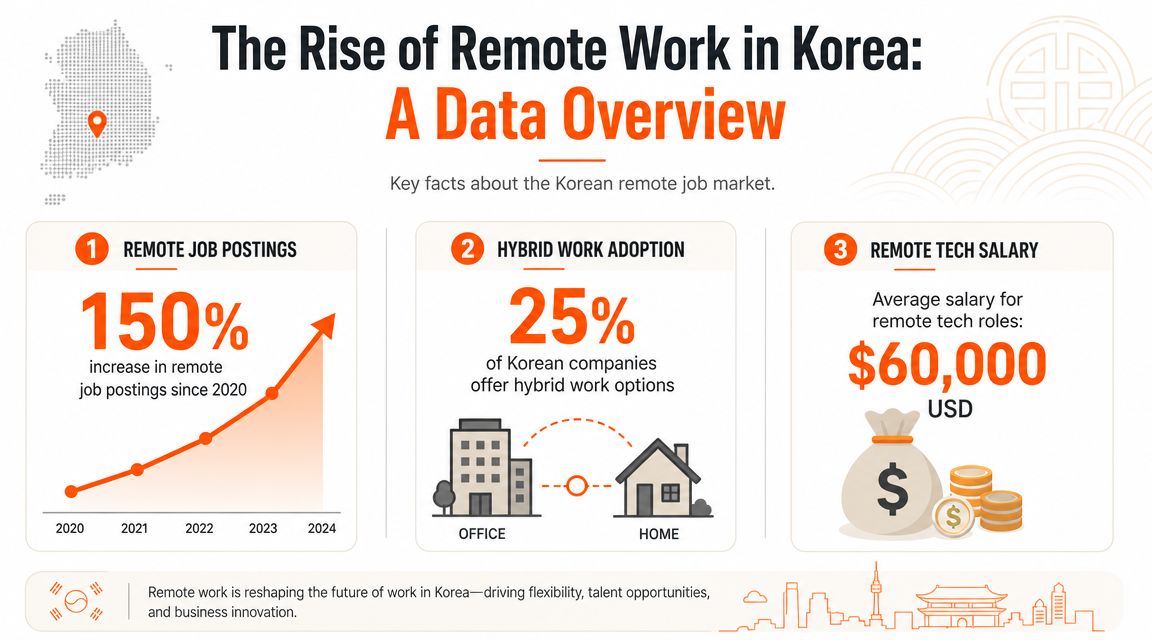
Growth happened fast, but from a low base
The headline growth is real. So is the limitation.
Stanford's Institute for Economic Policy Research noted in its working from home 2025 overview that working from home is highest in North America, the UK, and Australia, and lowest in Asia. The same comparative research described South Korea as having the least remote work hours among 40 countries for college-educated workers, at roughly 0.5 days per week.
That's the key market truth. Korea has grown into a credible remote-work environment, but average remote-work intensity still sits well below the leading English-speaking markets.
Not every employer adopted remote work equally
The second reality is structural. Korea isn't one uniform labor market.
Research published in Frontiers in Public Health on Korea's dual labor market and remote work found that remote work adoption was much more common in large corporations and public institutions than in SMEs. The study also found that the share of remote workers rose 6-fold from 2019 to 2020, but the increase was concentrated in sectors such as finance, insurance, real estate, transportation and communication, and public social service.
That matters because many international job seekers assume startups and SMEs will be the easiest entry point. In Korea, that often isn't true. Smaller firms may be less equipped for distributed collaboration, less willing to handle legal complexity, or more office-centric.
Korea has a real remote market. It just isn't broad-based. Most of the practical opportunity clusters around employers and sectors that can coordinate digitally without much friction.
What this means for your search
If you're targeting remote jobs in Korea, keep these expectations grounded:
- Expect concentration, not abundance. The strongest openings tend to sit in digital, knowledge-heavy functions.
- Expect employer differences. Large firms and better-organized companies are usually more realistic targets than small offline-heavy businesses.
- Expect selectivity. Employers often screen hard for language, legal eligibility, and readiness for distributed work.
That combination can feel restrictive. It also makes the market easier to handle once you stop treating every remote listing as equally viable.
Navigating Visas and Legal Requirements
For foreigners, this is usually the make-or-break issue. You can have the right skills, the right industry background, and strong Korean market knowledge. If your legal pathway doesn't match the job structure, the process stalls.
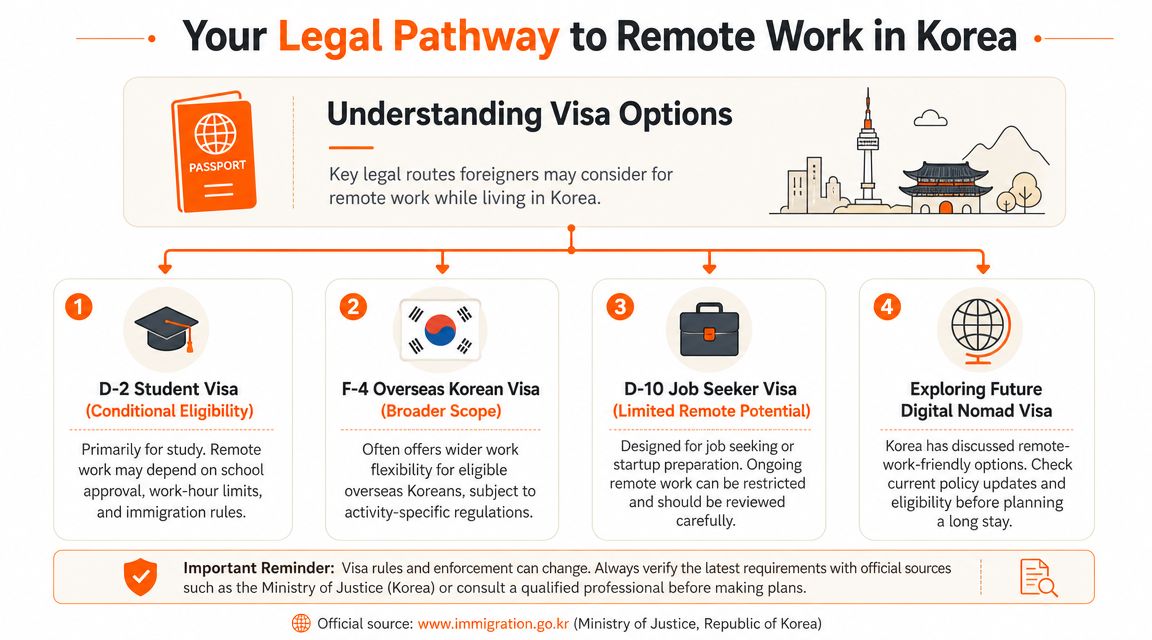
Path one if you work for a foreign company from Korea
This is the cleanest path for many digital professionals. Your employer is outside Korea, your work is already remote-friendly, and you want to live in Korea while continuing that job lawfully.
The practical question isn't just “Can I do remote work?” It's “Under which visa or residency basis can I stay in Korea while doing it?” If you're assessing country rules more broadly before narrowing in on Korea, this guide on working remotely abroad is useful for understanding the bigger compliance picture.
Admin details matter more than people expect. Employers, banks, and service providers often ask for local contact information, and getting that sorted early reduces friction. If you need help understanding local formatting and setup issues, this guide to Korean phone numbers is particularly useful.
Later in your move planning, this video gives a practical overview of the visa environment many foreign professionals start with:
Path two if you want a remote role with a Korean employer
Many remote job searches become messy. A listing may say remote, but the employer may still require local work authorization, office attendance on some schedule, or a contract setup that only works for residents.
There's another complication. The phrase remote jobs Korea often mixes two different markets: jobs for people physically in Korea, and jobs for Korean-speaking candidates anywhere. Data summarized through Glassdoor's South Korea remote listings view shows that some platforms display only a small number of in-country remote roles while others show far more Korean-language remote openings. That suggests language ability can matter more than physical location for many roles.
If you're a foreign candidate, that changes your positioning:
- Korean speaker abroad: You may fit language-tied roles even if the company doesn't care that you live outside Korea.
- Foreigner in Korea without Korean proficiency: You may qualify for specialist roles, but your target pool is narrower.
- Candidate needing sponsorship: You need to check whether the employer has any history of handling visa-linked hiring before you spend time applying.
Employers don't reject remote applicants only because they're foreign. They often reject them because the legal setup, payroll path, or communication model looks unclear.
Path three if you're a Korean national or already hold broad work rights
This group has the simplest route. If you're a Korean citizen or hold status that gives broad work flexibility, your search can focus more on role fit, sector, and employer policy than on immigration hurdles.
Even then, don't assume every remote listing is fully location-agnostic. Some roles are remote inside Korea, not remote from anywhere. Others are hybrid but labeled loosely. Read the contract language carefully before treating a role as fully distributed.
Top Industries and Remote Roles in Korea
The best remote opportunities tied to Korea are concentrated in work that can move across time zones, ship digitally, and be evaluated by output instead of physical presence. That's why the market leans toward knowledge work rather than broad office work.
According to Dev Korea's job board patterns and metadata, the highest density of remote opportunities tied to Korea appears in software development, UI/UX, project management, data analysis, technical support, and customer service. The same source notes that postings often indicate visa sponsorship status and remote-work availability, which makes those fields especially practical for foreign candidates who need to screen quickly.
Where the strongest fit usually appears
Some roles travel well across borders. Others don't.
The most workable categories in the Korean remote market tend to include product-building roles, digital operations, and customer-facing work for global or multilingual teams. That lines up with what many recruiters see in practice: when a company can define deliverables clearly and collaborate through tools rather than physical supervision, remote becomes more feasible.
For a broader sense of which work-from-home roles are staying in demand across markets, Go Hires' insights on remote work are a helpful comparison point.
Remote job opportunities in Korea by industry
The table below is directional, not a salary database. Because the verified source set doesn't provide salary figures by role, the final column reflects qualitative market positioning rather than invented pay bands.
| Industry | Common Remote Roles | Estimated Salary Range (USD) |
|---|---|---|
| Software and IT | Software Engineer, Backend Developer, Frontend Developer, Mobile Engineer, Technical Support | Varies by employer and seniority |
| Product and Design | UI/UX Designer, Product Designer, Product Manager, Project Manager | Varies by employer and seniority |
| Data and Analytics | Data Analyst, BI Analyst, Operations Analyst | Varies by employer and seniority |
| Customer and Operations | Customer Success, Customer Support, Technical Account Support | Varies by employer and language requirements |
| Marketing and Growth | Digital Marketer, Content Marketer, Growth Specialist, Localization Marketing | Varies by employer and market scope |
| Cross-border Business Functions | Sales Support, Partner Operations, Regional Coordination | Varies by employer and regional responsibility |
How to choose roles that are actually viable
A smart shortlist usually has three traits:
- The work is digitally deliverable. Engineering, design, analytics, and project coordination tend to pass this test.
- The team is already cross-border. If the company serves multiple markets, remote coordination is easier to justify.
- The listing includes operational detail. Visa sponsorship, location scope, language requirements, and employment type are all green flags because they show the company has thought through the setup.
The biggest mistake here is chasing job titles without checking the operating model. A remote-looking title at an office-centric company often leads nowhere. A less glamorous title at a distributed team can be far more realistic.
Where to Find Genuine Remote Job Listings
Most frustration in the remote jobs Korea search comes from bad sourcing, not bad candidates. The same role can be duplicated, mislabeled, geo-restricted, or posted in a way that hides whether it's remote, hybrid, or only remote for certain countries.
That's why platform strategy matters.
According to Indeed's Seoul remote listings view, visible remote job counts can vary widely by platform. In the verified data set, one snapshot showed 284 remote jobs in South Korea on Glassdoor while Indeed showed 17 remote openings specifically tagged for Seoul. The lesson isn't that one platform is right and the other is wrong. It's that opportunity is concentrated in different ecosystems, and your interpretation of job volume depends heavily on where you search.
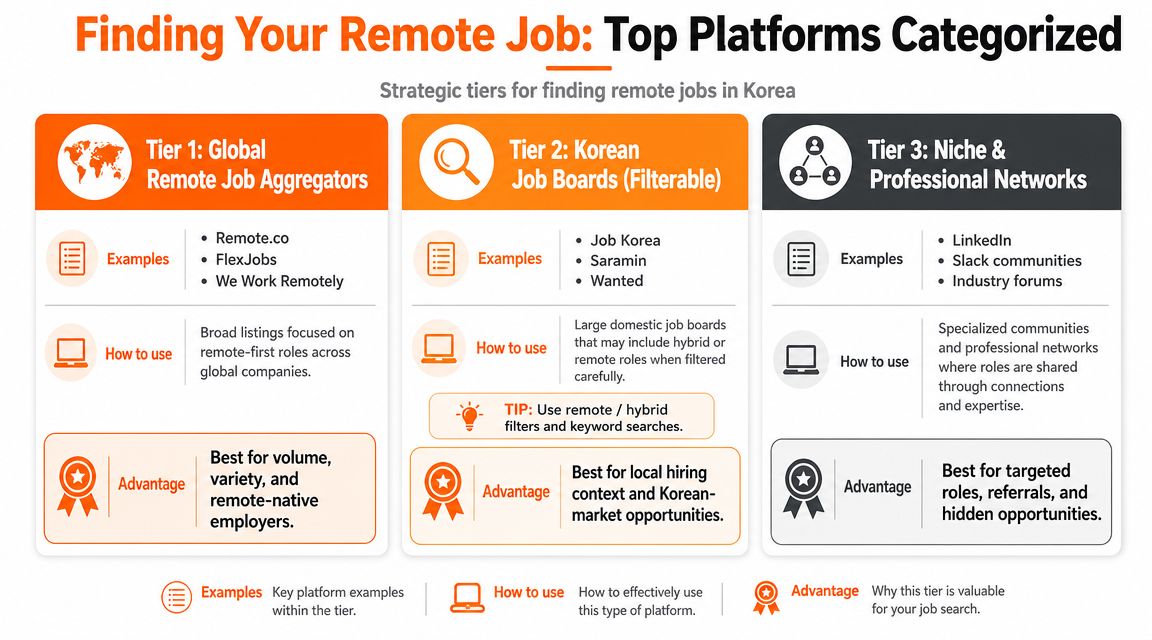
Tiered search works better than single-platform searching
Here's the approach that tends to save the most time.
| Search tier | What it's good for | Main weakness |
|---|---|---|
| Global remote aggregators | Discovering distributed roles that may include Korea-related language or market requirements | Some listings aren't truly Korea-specific |
| Korea-focused boards | Finding roles closer to local employer reality and industry norms | Remote filters can be inconsistent |
| Direct company career pages | Confirming whether remote policy is real and current | Slower, more manual process |
What to do on each tier
- Global platforms: Use filters for job function, timezone compatibility, and language where possible. This works well for Korean-speaking roles that aren't tied to Korean residency.
- Local boards: Search in both English and Korean if you can. Many viable roles won't appear if you only use English keywords.
- Company pages: Target firms already known for digital workflows, regional hiring, or international customers. Their career pages often reveal more than the aggregator summary.
The best listings usually survive scrutiny on three levels: the board says remote, the job description explains the location scope, and the company careers page confirms the policy.
What doesn't work well
Blindly trusting the label “remote” is the fastest way to waste applications.
Be careful with listings that:
- Hide geography. If the post never clarifies where you can legally work from, treat it cautiously.
- Skip language detail. If the role serves Korean customers or teams, missing language requirements can signal a low-quality repost.
- Look over-aggregated. Duplicate titles across several boards often inflate the apparent market size.
The strongest search habit is simple: verify every promising listing twice before you apply.
How to Craft a Winning Application
Once you've found a role that's viable, your application has to do two jobs at once. It must show that you can perform the work, and it must reduce the employer's uncertainty about hiring you remotely.
A generic international resume usually doesn't do that. Korean employers and Korea-linked teams often want clearer evidence of structure, relevance, and communication fit than candidates expect.
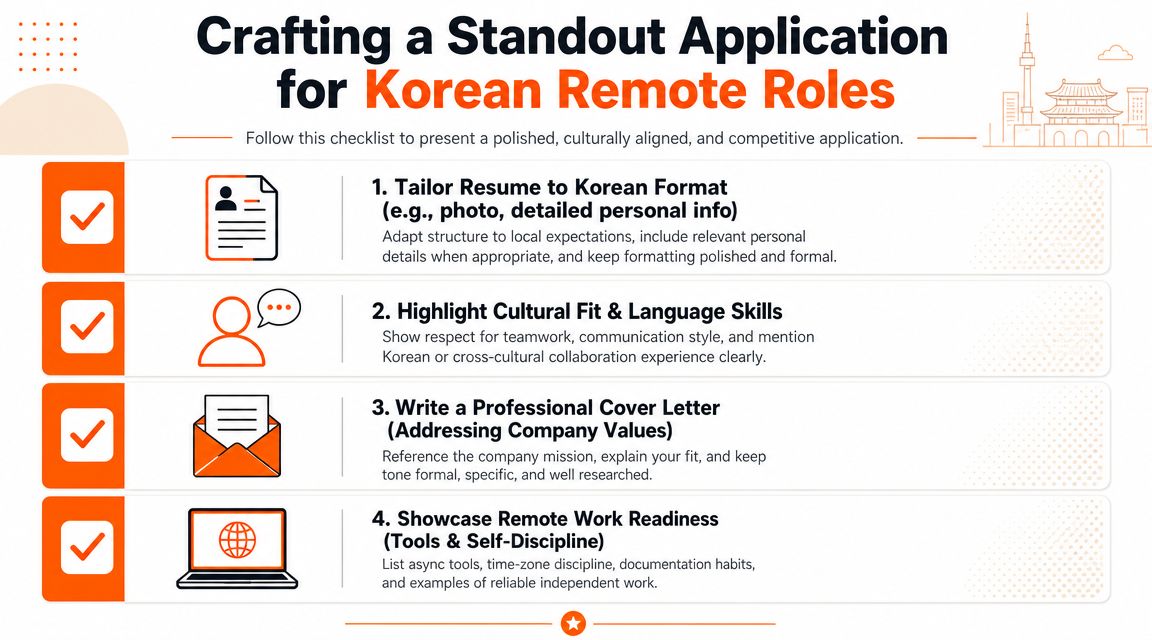
Show fit before personality
Start by tightening the basics.
Your resume should match the language of the job description closely, especially for tools, product areas, customer segments, and collaboration methods. If the listing mentions cross-functional delivery, localization, stakeholder coordination, or support for Korean users, mirror that language where it's true.
Don't rely on vague remote claims like “works well independently.” Replace them with specifics such as async collaboration, documentation habits, customer handoff experience, or managing projects across time zones.
Address the employer's hidden objections
Many hiring teams won't state their concerns directly. They'll move on if your application leaves open questions.
A strong application answers these points early:
- Work eligibility: State clearly whether you already have the right to work locally, need sponsorship, or are applying for an external remote arrangement.
- Language scope: Be direct about your Korean and English working level if the role touches local teams or customers.
- Remote readiness: Mention the tools and workflows you've used to ship work without office dependence.
- Timezone practicality: If you're abroad, show how your overlap with Korea works in practice.
For resume keyword alignment and screening prep, a focused read on how to beat ATS can help you tighten phrasing before you apply.
“Remote-ready” isn't a personality trait. It's evidence that you communicate clearly, document well, and don't create coordination risk.
Tailor your materials to the role, not just the country
A Korean tech employer hiring an engineer won't read the same way as a Korean consumer brand hiring a marketer. Tailor for the function first, then the market.
Use this short checklist:
- Rewrite the summary line. Mention your exact specialty and the market or user context you support.
- Reorder experience. Put the most relevant cross-border or remote work first.
- Make communication visible. Include collaboration with product, sales, support, or local market teams where relevant.
- Add a short note on logistics. This can sit in your cover letter or email, not necessarily on the resume.
Candidates often over-focus on “cultural fit” and under-focus on operational clarity. Hiring managers usually care more about whether you'll be easy to hire, easy to onboard, and easy to work with across distance.
Your Next Steps to a Korean Remote Job
Remote jobs in Korea are real, but they're not broad enough to reward a casual search. The people who land them usually do five things well. They understand the market as it works, choose the right legal pathway, target remote-friendly functions, search across the right platform mix, and submit applications that remove uncertainty.
That's the practical version of the Korea remote-work dream. Less fantasy, more precision.
If you're also preparing for relocation itself, not just the job hunt, these 2026 moving abroad insights are a good companion read because they cover the wider transition issues job seekers often ignore until late.
The best next move is to narrow your target list. Decide whether you're applying as a Korea-based resident, a foreigner planning a move, or a Korean-speaking candidate who can work from anywhere. Once that part is clear, the rest of the search gets faster and far less frustrating.
If you want one place to start, browse roles on YayRemote and use its filters to focus on distributed jobs by function, experience, and work setup. It's also useful for the practical side of the process, including tools for resume optimization, skills matching, and comparing collaboration across time zones.